Tuesday, 22 May 2018

Jebel Shams: A Salute to the Sun


The enormity of the landscape is astounding. 

It tells the million-year-old story of the geological upheavals that created the canyons, the tremendous pressure that shook the ocean floor and exposed the earth’s insides and laid them out in folds and layers of molten stone and sand. 

The echo of the rumble can still be felt in an inaudible visual gasp.

Perhaps it had happened in a multitude of millions of years...or perhaps in the scope of a single day. 

The sun has been a silent witness to the epical unfolding of this topographical drama.

This is the place where the sun’s rays plant the first kiss on the Omani soil every morning. 

A Surya Namaskar, a salute to this mighty sun...

/Om Mitraaya Namah /

One who is friendly to all

There were eleven of us, friends and friends of friends – Surya, Anna, Royce, Sanaa, Reena, Bindu, Raju, Deepmala, Balaji, Stephen and I.

The heat in the city of Muscat during the month of May can hit dizzying records. It was a warm and inviting sun which greeted us at 7.15 am when we started our journey towards the Hajar Mountain Range in Northern Oman which features the highest peak in the country, Jebel Shams – the Mountain of the Sun, and Wadi Ghul – the Grand Canyon of Arabia.


/Om Ravaye Namah /
One who shines

The radiance followed us as our 4WDs moved from city speeds of 100 km/h to highway speeds of 120 km/h. Bindu, Deepmala, and I took the steering wheels while Balaji, Raju, and Stephen coordinated with each other about navigation. 

We took a short halt at a wayside eatery and discussed the road strategy ahead. The next halt was uphill to take in the view. That was when we came across the first of the several mountain goats we saw on our trip. She eagerly feasted on orange rinds – the only treats we could give her.


/Om Suryaya Namah /

One who dispels darkness and generates activity

Full of positive spirit, and taking turns at the steering wheel, we approached the Jebel Shams Resort at 11.30 am. 

Raju had used his negotiation skills to get a good deal on the current rates at the resort. Perched near the canyon, the resort offers a cluster of chalets having all the basic amenities for a comfortable overnight stay, a swimming pool, and a wonderful view of the sunset. 

Each chalet has a barbecue pit in the back which held a special interest for Surya and Royce. At the picnic tables, Anna and Sanaa sipped on cool drinks.
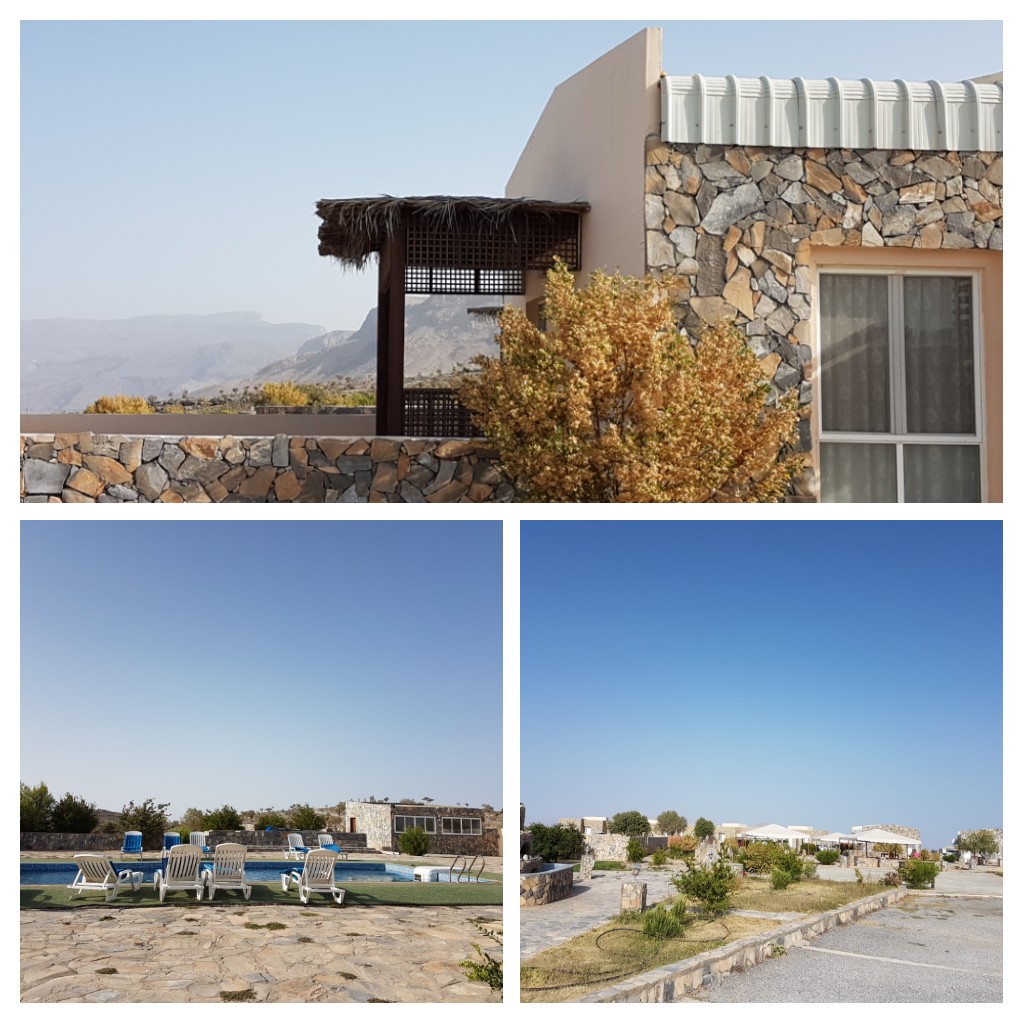

/Om Bhaanave Namah /

One who illuminates 

Although bright, the temperature was moderate at the height of approximately 2,800 m. 
Mountain goats with long hair in shades of cream and brown cleverly climbed up in impossible places like the tops of skeletal trees.  Some of them took shelter from the strong light under whatever feeble  shade they could find.


/Om Khagaya Namah /

One who is all-pervading, one who moves through the sky

It was a calm day and bunches of pure white clouds floated idly in the sky. 
In the blazing mid-day sun, basked high-flying Egyptian Vultures. 

Meanwhile, three engineers in our group debated about the direction in which their droppings would fall. Stephen was quite sure it would be on his head. 


/Om Pooshne Namah /

One who gives nourishment and fulfilment

Balaji had thoughtfully packed homemade tamarind rice and lemon rice for lunch. Raju and Stephen had brought snacks and drinks. 

The resort staff provided a sumptuous Arabic dinner and a continental breakfast. It was incredible to eat such wholesome food in the inhospitable terrain where we had planned to stay overnight.

On our evening walk, we came across an Omani colleague of Balaji and Stephen who was driving back home with his family. He stopped to offer us fresh, sun-blushed apricots – a bounty of the rugged mountains. 


/Om Hiranya Garbhaya Namah /

One who has a golden- coloured brilliance

The setting sun brought a soft golden glow to the landscape. With a little coaxing, Sanaa was inspired to sing melodiously – 

“Tonight the super trouper
Lights are gonna find me
Shining like the sun
Smiling, having fun
Feeling like a number one.”  


/Om Mareechaye Namah /

One who gives light with infinite rays

The raw morning sun rays touched the mountain.

They shone on flaming pomegranate flowers and bushes of pink roses. Wide awake, goats bleated morning greetings in the distance.  The chill slowly gave way to warmth.

My early morning walk fetched a unique discovery – a dried up clump of low vegetation with translucent leaves so fragile that they would crumble if touched. The rays of the sun passed through the leaves as if they were made of clear glass. 


/Om Adityaaya Namah /

One who is the son of Aditi, the cosmic divine mother

Along the stone paths, Deepmala noticed fossils of small ancient sea creatures embedded in the black rocks streaked with white marble. 

It was impossible to lose track of the geological history of the landscape while walking around these mountains.


/Om Savitre Namah /

One who is responsible for life

Jebel Shams stands tall at more than 3000 m but what is more fascinating is the deep Wadi Ghul lying alongside it. The Wadi or dry riverbed is also called the Grand Canyon of Arabia because of the deep vertical fissure it exposes. 

Several species of cacti and sparse vegetation thrive here in isolated patches. A few houses of local shepherds and a pop-up stall selling handicrafts made from goat hair were the only signs of civilization in these parts. 


/Om Arkaaya Namah /

One who is worthy of praise and glory

 Reena, who has flown the nest to join college overseas, draped her arm around her mum's shoulders and chatted animatedly with her.

The starkness of nature here contrasts vividly with the security of being with people you love.
Thoughts of gratitude for divine blessings arise. 


/Om Bhaskaraya Namah /

One who gives wisdom and cosmic illumination

A spray of innumerable stars graced the moonless sky at night.
Witnessing such celestial majesty brings home the truth of our own insignificant lives. 

Bindu cleverly captured a shooting star on her phone camera.
 
For those of us who missed this heavenly sight, there is always a next time.
Inshallah!

Monday, 14 May 2018

Tatkar: Racing Music and Matching Footwork


To mark the International Dance Day on 29th April, the Leelangika Kathak Group, led by their guru, Jhumpa Chakraborty, held a Tatkar Competition.

Jhumpa is a member of The International Council of Dance or CID which is the official umbrella organization for all forms of dance in all countries of the world. It is a non-governmental organization founded in 1973 within the UNESCO headquarters in Paris where it is based. 

The art of dance visually represents the tradition, culture, and music of the people. Dance competitions bring to the forefront the true form of this art. 
In the Kathak dance form, tatkar is a type of rhythmic footwork. During a competition the intensity of the tabla beat is increased gradually and the dancers’ feet have to keep up with the racing beat. 
 
At the Leelangika Tatkar Competition, the participating girls were put into five groups according to their ages and all the groups were differentiated by the colours of their dupattas – pink, blue, red, yellow, and green. 

The competition took place in a hall decked up with curtains of multicoloured dupattas by enthusiastic mothers. As the full April moon climbed up the sky, the competition saw the tatkar beat get more and more vigorous. The dancers seemed to have achieved a trance-like condition of body and mind as they matched music and movement. 

The evening ended with a prize-distribution ceremony and Ms. Chakraborty awarded the trophies and certificates. In Group 1 (6-8 years) Jahnabi bagged the first prize and Juana won the second position. In Group 2 (9-14 A years) Anna got the first prize while Rupsa and Kena bagged the second and third positions respectively. In Group 3 (9-14 years B) Aditi was declared as the best performer while Shaivi and Vyatiba came in second and third respectively. In Group 4 (15-18 years) Sneha stood first and Aditi was second. In Group 5 (20+ years) Anushaily was first and Zanam won the second position.

Jhumpa was most proud of the youngest girls in the group and encouraged all the participants who had given their best. 


This report was also published in Muscat Daily, 3 May, 2018.

Sunday, 15 April 2018

Musandam - A Weekend Break


Friday

The 7.00 am flight from Muscat to Khasab prepares to land. 

As depicted in movies about magical creatures, sharp, serrated mountain crowns thrust out of fleecy, formless white clouds. A breathtaking vista opens up – rock formations in varying hues of gold and grey, tiny islets and coral reefs, a stunning coastline. 


Khasab is the main city of the Musandam peninsula. Musandam, a governorate of the Sultanate of Oman, separates the Arabian Gulf from the Sea of Oman.
On landing, the airport and its surrounds give the feel of a small town where tourism is a thriving occupation. Tall, towering mountains, eroded through the ages, bring to mind the carvings in South Indian temples. 

In the airport transfer van provided by the hotel, a group of four passengers join us.

The elderly gentleman in shorts takes up the front seat beside the driver. The elderly lady with brown hair sits with a petite blonde young girl of about twenty on the back seat.

As the van is about to leave, a shiny-skinned dark girl enters and takes up the empty seat beside me. With her hair tied up in a turban with a few curls stubbornly pushing out over her forehead, she looks like a goddess.

The elderly lady talks in a monotone in an unfamiliar language. The three others nod to her remarks from time to time. They seem like odd pieces of a jigsaw puzzle. 

The van passes by the Khasab Castle and the only supermarket in town, winds through streets lined with little outlets offering dhow cruises, mountain safaris, and car rentals. A big goat, with a thick brown velvety coat, sits sphinx-like with front legs crossed on the top of a cliff overlooking the blue-green sea.

After checking-in at the hotel and having breakfast, we head to the cliffs jutting out into the sea. The receding tide has revealed an evenly surfaced rectangular rock covered slightly with barnacles. Just below the surface of the water, tiny grey, green, yellow, and orange fish gleam in the morning sunlight. Not far away a couple of snorkelers revel in their interesting adventures. 


At 1.30 pm, we boarded a traditional Arabian wooden dhow for a cruise. The seawater-filled canyons along the shoreline north of the Musandam peninsula  have created narrow fjord-like inlets. This area is famous in the tourism circuit as the ‘Norway of Arabia’. 

A wizened old Omani gentleman with a kindly smiling face expertly guided the dhow through the fjords to Khor Shamm - the place where resident Indo-Pacific Humpback Dolphins come to play. Our whistles attracted them and they put up a synchronised show.


The fjords were majestic with a handful of houses nestling between the folds of the mountains. Kumzar, a coastal village in the northernmost tip of Khasab, is enclosed on all three sides by inaccessible mountains. 


Richard, our friend, who had once visited Kumzar for work on the Ministry of Tourism administration building, remarked, “I saw that the goats there ate dried fish in the absence of any vegetation”. Tourists can only view the village from afar and imagine life there with its own unique Kumzari language and culture. 


At the Telegraph Island, on which the British had built a repeater station for telegraphic messages in the 19th century, the green waters were inviting for a dip. Snorkels bobbed up and down as boats anchored and departed. A large sea urchin found near the steps to the hill deterred those who wanted to climb up.
Back at the hotel, we saw a young couple who had spread a mat and camped on a barnacle-covered cliff. They were fishing with the intention to have a barbecue dinner by the sea. 

Along the poolside, the passengers from the airport van sat on four deckchairs placed at equal distances. The elderly gentleman and the lady were at extreme left and right respectively. Between them sat the two young girls – the dark one on the left and the fair one, with one of her foot bandaged, on the right. A full moon threw an enigmatic brightness over their shadowy faces.

None of them spoke. 


Saturday


An old man practised Tai Chi facing the sea at 6 am. Fishermen on their boats hurled their nets for an early morning catch. A big turtle flashed its patterned back. 

We browsed through tourist information booklets for things to do and learn about the lifestyle of the people of the peninsula:

‘Although accessible by road, air and sea, Musandam has several cultural traditions which are different from the rest of the country. The local people are a semi-nomadic community farming their hillside terraces in the winter and living by the coast in summer to fish and harvest dates – their summer homes palm frond huts, their winter ones low stone houses that blend almost invisibly into the mountainsides. The men carry a traditional stick with a small axe fixed to the top locally called Al Jirz.’ 

We took a private guided safari to Jebel Harim – the Mountain of Women – so called because it was the women who took care of young children, farms, and animals while the men went down to the coast for fishing and defence for extended periods of time. 
At 950 meters, among the barren mountains, we found bright green foliage – aerial plants that absorb moisture from the air and release it into the soil.


A dry wadi had eroded the black stone and created amphitheatre-like formations which would hold clear pools of water whenever it rained in these parts. 


 An old cemetery with tombstones gives testimony to the advent of Islam in the region. Healthy mountain goats and donkeys seek shade under sparsely-leafed trees. A cool, stone house with sections and windows crouched by a hill with a fig tree by the front door. 


While taking in the splendour of the scenery, a unique rock formation catches our eye – a tall silhouette of a ‘Rock Man’ accompanied by an army of ‘rock soldiers’.


Our guide, HB, leads us to a “fish market” – fossils of fish embedded in the black stones. 


He has brought dates along to feed donkeys and goats. 


The canyons stretch as far as eyes can see.”On the other side” informs HB, “is United Arab Emirates. The Musandam peninsula of Oman, lies at the north of U.A.E.”

On the way back, we went atop Khor Najid, one of the fjords in the Sea of Oman, which offered a view of sailing boats on a small white beach. 


“Bellisimo!”
HB, whose favourite language was Italian, regaled us with stories about how he had learned foreign languages from tourists. When the scenery got monotonous, HB entertained us with his extraordinary home remedies and concoctions for various illnesses.

At regular intervals along the road back to the hotel, the puff pastry-like hills sandwiched brightly-coloured new villas. 


“The people from the stonehouses have moved into these palaces now” informed HB.

The dark girl came by herself for a swim in the pool in the evening. But she did not smile or talk to anyone. She swam with calm, slow strokes. She was beautiful.

The April night air was balmy and the moon beamed.
Dinner outdoors under the moonlight was delightful for all hotel guests. Two little English boys boasted about getting 'Albus Dumbledore' in a Harry Potter card game.

The four passengers had their dinner quietly in the indoor restaurant. 

Sunday

A hurried breakfast. 

The four passengers were seated in the airport van before us. The elderly gentleman wished us a booming “Good morning”. The dark girl was sitting beside him. The other two ladies sat behind them. The elderly lady was particularly talkative.

At the airport, we glanced through an Arabic newsletter which had glorious pictures of members of the Omani royal family and the armed forces. We watched an army helicopter land and passengers arriving by Oman Air. As we boarded, a man’s cap flew away with the breeze and landed near the plane’s wheels. The security retrieved it. 

The elderly lady and the fair girl were laughing and smiling at something as they sat next to each other.

The elderly man and the dark girl sat behind us. They were holding hands.  


Wednesday, 11 April 2018

Why do you talk so much...?


Over the kitchen sink, I talk to myself sometimes. Out loud, not in my head.
When our pet Moofi was around, he would be swimming in his little glass bowl and pretending to listen, opening his mouth every now and then for mute comments. But since he passed away, I am like someone who has lost her marbles. 

Talking to myself helps to sort things out in my head. But sometimes, I feel I should have just let things be without putting them into words. 

The other day, while I was talking away to myself about a sudden notice about moving house, A was looking up some stuff I had put in a letter stand on the counter. Among visiting cards, photos and envelopes, it had little quotes that I had scribbled on stick-on notes.

"It would feel like someone had died..." I talked to myself. 
"A sudden move like this...a notice out of the blue...such comfort this house has given us for so many years...the friends we entertained...family who visited...neighbours we are affectionate with...to have this house razed to rubble...yes, it is about half a century old and coming apart, but we love it... and now to look for a new house...when summer is on the doorstep...will miss this house so much....the wild garden with its four broken chairs that we still use...the tree house that S built for A and her friends...the tyre hanging from a tree branch that children cannot resist swinging on...the faded yellow and green hammocks...and the wadi cats who have adopted us...we will miss them so much..."

"WHY DO YOU TALK SO MUCH WHEN YOU KNOW SO LITTLE?" 

This question from A startled me. 
Turning around, I asked her,
"Where did that come from?"
"Found it here, in your stuff. It is what God said to Job."

It was such a profound question. I needed to be reminded of it every time so I told A to display it in a place in a kitchen where I would see it whenever I talked to myself.